
India PIN Code Guide – Zones, Structure & Finder Tool
India’s postal system runs on a simple but powerful 6-digit code — the PIN Code. Every city, town, and village in India has its own unique India PIN Code, and knowing the Pincode of my location can help with everything from tracking a parcel to filling out a government form or verifying your address for KYC. This complete India PIN Code Guide covers everything you need to know — what a PIN Code is, why it matters in daily life, how each digit is structured, which postal zone your state belongs to, the full history of India Post, and a free map-based PIN Code finder tool that helps you find the Pincode of my location instantly by clicking on the map.
Whether you are a student, a professional, or just curious — this is the only PIN Code resource you will ever need.
About PIN Code & India Post
Your complete guide to India’s Postal Index Number system — understand every digit, explore postal zones, trace the history of India Post, and find any PIN Code instantly.
A Postal Index Number (PIN Code) is a unique 6-digit numerical code assigned by India Post to every delivery area across the country. Launched on 15 August 1972 by Shriram Bhikaji Velankar, the system was designed to eliminate confusion caused by similar place names and regional language differences.
Every digit in a PIN Code carries a specific meaning — from the broad geographical zone right down to the exact post office responsible for delivering your mail. This intelligent system powers one of the world’s largest postal networks, ensuring that 1.64 lakh+ post offices across India can route letters, parcels, and documents swiftly and accurately.
From shopping online to opening a bank account, your PIN Code plays a critical role in everyday life. Here is why every Indian must know their correct PIN Code:
Faster Mail & Parcel Delivery
PIN Codes allow post offices and couriers to sort and route your parcels automatically — ensuring quick, error-free delivery right to your doorstep.
Online Shopping & E-commerce
Every time you place an order online, your PIN Code determines delivery availability, estimated arrival dates, and shipping charges in real time.
KYC & Identity Documents
Aadhaar, PAN, voter ID, and other official documents require a valid PIN Code to verify and authenticate your permanent residential address.
Location-Based Services
Food delivery, cab booking, mobile recharge, utility payments — all use your PIN Code to verify your location and connect you to nearby services.
Banking & Financial Services
Banks and NBFCs use PIN Codes for KYC verification, loan eligibility checks, branch assignment, and fraud prevention across their networks.
India’s postal heritage dates back over 700 years. From horse-carried letters in medieval times to a fully digital network today, India Post’s evolution is a fascinating story of connectivity and service.
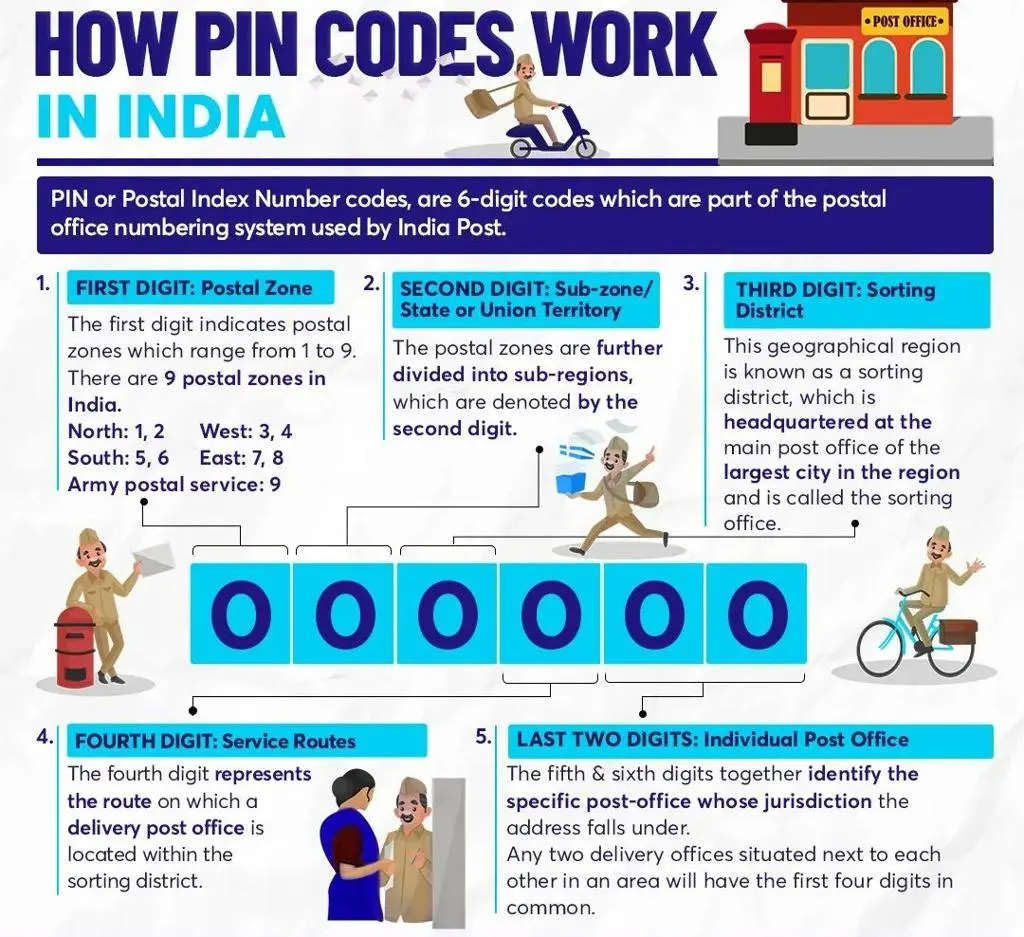
The very first digit of a PIN Code identifies one of 9 postal zones in India. The first 8 zones represent geographical regions, while Zone 9 is exclusively reserved for the Army Postal Service (APS).
| First Digit | Postal Zone | States & Union Territories Covered |
|---|---|---|
| 1 | Northern | Delhi, Haryana, Himachal Pradesh, Punjab, Chandigarh, Jammu & Kashmir, Ladakh |
| 2 | Northern | Uttar Pradesh, Uttarakhand |
| 3 | Western | Gujarat, Rajasthan, Dadra & Nagar Haveli and Daman & Diu |
| 4 | Western | Maharashtra, Madhya Pradesh, Chhattisgarh, Goa |
| 5 | Southern | Andhra Pradesh, Karnataka, Telangana |
| 6 | Southern | Kerala, Tamil Nadu, Puducherry, Lakshadweep |
| 7 | Eastern | West Bengal, Odisha, Assam, Arunachal Pradesh, Manipur, Meghalaya, Mizoram, Nagaland, Tripura, Sikkim, Andaman & Nicobar Islands |
| 8 | Eastern | Bihar, Jharkhand |
| 9 | Functional | Army Postal Service (APS) — used exclusively by the Indian Armed Forces |
Each of the 6 digits in a PIN Code has a specific, deliberate purpose. Understanding this structure helps you decode where any Indian post office is located — just from its PIN Code.
| Digit Position | What It Represents | Meaning | Example — 110001 |
|---|---|---|---|
| 1st Digit | Postal Zone | One of 9 broad geographical zones across India | 1 → Northern Zone |
| 2nd Digit | Sub-Zone / Circle | State or linguistic region within the zone | 1 → Delhi Postal Circle |
| 3rd Digit | Sorting District | Revenue district or administrative sorting area | 0 → New Delhi District |
| 4th–6th Digits | Delivery Post Office | Unique code for the specific post office handling final delivery | 001 → New Delhi G.P.O. |
The first two digits together identify the exact Postal Circle — the state or regional administrative unit. Use this table to instantly identify which state any Indian PIN Code belongs to.
| First 2 Digits | Postal Circle | States & Union Territories Covered |
|---|---|---|
| 11 | Delhi | Delhi |
| 12–13 | Haryana | Haryana |
| 14–16 | Punjab | Punjab, Chandigarh |
| 17 | Himachal Pradesh | Himachal Pradesh |
| 18–19 | Jammu & Kashmir | Jammu & Kashmir, Ladakh |
| 20–23, 25, 27–28 | Uttar Pradesh | Uttar Pradesh |
| 24, 26 | Uttarakhand | Uttarakhand |
| 30–34 | Rajasthan | Rajasthan |
| 36–39 | Gujarat | Gujarat, Dadra & Nagar Haveli and Daman & Diu |
| 40–44 | Maharashtra | Maharashtra, Goa |
| 45–48 | Madhya Pradesh | Madhya Pradesh |
| 49 | Chhattisgarh | Chhattisgarh |
| 50 | Telangana | Telangana |
| 51–53 | Andhra Pradesh | Andhra Pradesh |
| 56–59 | Karnataka | Karnataka |
| 60–64 | Tamil Nadu | Tamil Nadu, Puducherry |
| 67–69 | Kerala | Kerala, Lakshadweep |
| 70–74 | West Bengal | West Bengal, Sikkim, Andaman & Nicobar Islands |
| 75–77 | Odisha | Odisha |
| 78 | Assam | Assam |
| 79 | North East | Arunachal Pradesh, Manipur, Meghalaya, Mizoram, Nagaland, Tripura |
| 80–85 | Bihar | Bihar |
| 81–83 | Jharkhand | Jharkhand |
| 90–99 | Army Postal Service | Indian Armed Forces — worldwide postings |
From delivering letters in remote Himalayan villages to offering digital banking services, India Post has transformed into a modern multi-service organisation while staying true to its mission of connecting every Indian.
World’s Largest Postal Network
With 1,64,000+ post offices, India Post operates the single largest postal network on the planet — reaching every corner of the country.
Financial & Banking Services
India Post Payments Bank (IPPB), savings accounts, fixed deposits, life insurance (PLI/RPLI), and pension services all under one roof.
Express & Speed Post
Guaranteed time-bound delivery of documents and parcels across India and 97 countries through Speed Post and Express Parcel services.
Digital & Online Services
Track parcels online, apply for Aadhaar, passport, or insurance — India Post’s digital platform brings government services to your fingertips.
Global Connectivity
As a proud member of the Universal Postal Union (UPU) since 1876, India Post connects you to postal services in over 190 countries worldwide.
250+ Years of Postal Heritage
From Sher Shah Suri’s Dak system to IT 2.0 modernisation, India’s postal heritage spans over seven centuries of continuous public service.
FAQs
Final Thoughts
From a simple 6-digit number introduced on 15 August 1972 to the backbone of the world’s largest postal network — the PIN Code has quietly shaped how 1.4 billion Indians send, receive, and verify their addresses every single day. This India PIN Code Guide has walked you through everything — the meaning behind each digit, the 9 postal zones, the full list of postal circles, the rich history of India Post spanning 250+ years, and why your PIN Code matters more than you think.
And if you ever need to find a PIN Code quickly, our free India PIN Code finder tool is right here — just click on the map and get instant results. No login. No fee. Just accurate information, always.